.webp?width=205&height=50&name=LOGO_EN_LARGE%20(1).webp)

In St. George, one thing is certain: people love their trails. The city of just over 100,000 residents counted over 1.1 million passes on its trail network in 2024 alone.
The city is also a haven for nature lovers and tourists. Not far away, you’ll find both Zion and Bryce Canyon National Parks, big draws for outdoor enthusiasts.
With all these visitors, the city saw opportunity but also felt pressure to improve maintenance, safety, and connectivity on their trails—all while finding ways to further expand their network.
Facing rapid population growth without data
At one point in 2022, St. George was the fastest-growing metropolitan area in the country. Despite the population boom and the steady flow of tourists, St George didn’t have a single automatic counter to monitor trail usage in the city. The only data collected on their over 80 miles of multi-use trails came from volunteers counting people a few times a year.
The people of St. George knew that the trails were busy. They were just lacking the hard evidence to prove what they saw.
 People Climbing on the Red Rocks of Pioneer Park in St. George Utah. Credit: LMSwanson
Without count data to prove the need, many additional grants and funding seemed out of reach for the St. George. They also had no view of which trails were being used most, when people visited, and where trail expansions were needed. Before long, they knew they had to rely on something other than manual counting.
From zero to 25 counters in two years: how they solved their data problem
In 2023, the city decided to purchase 12 Eco-Counters. They went with MULTI counters and installed them at key locations on longer trail segments, targeting people using the trails for travel rather than leisure.
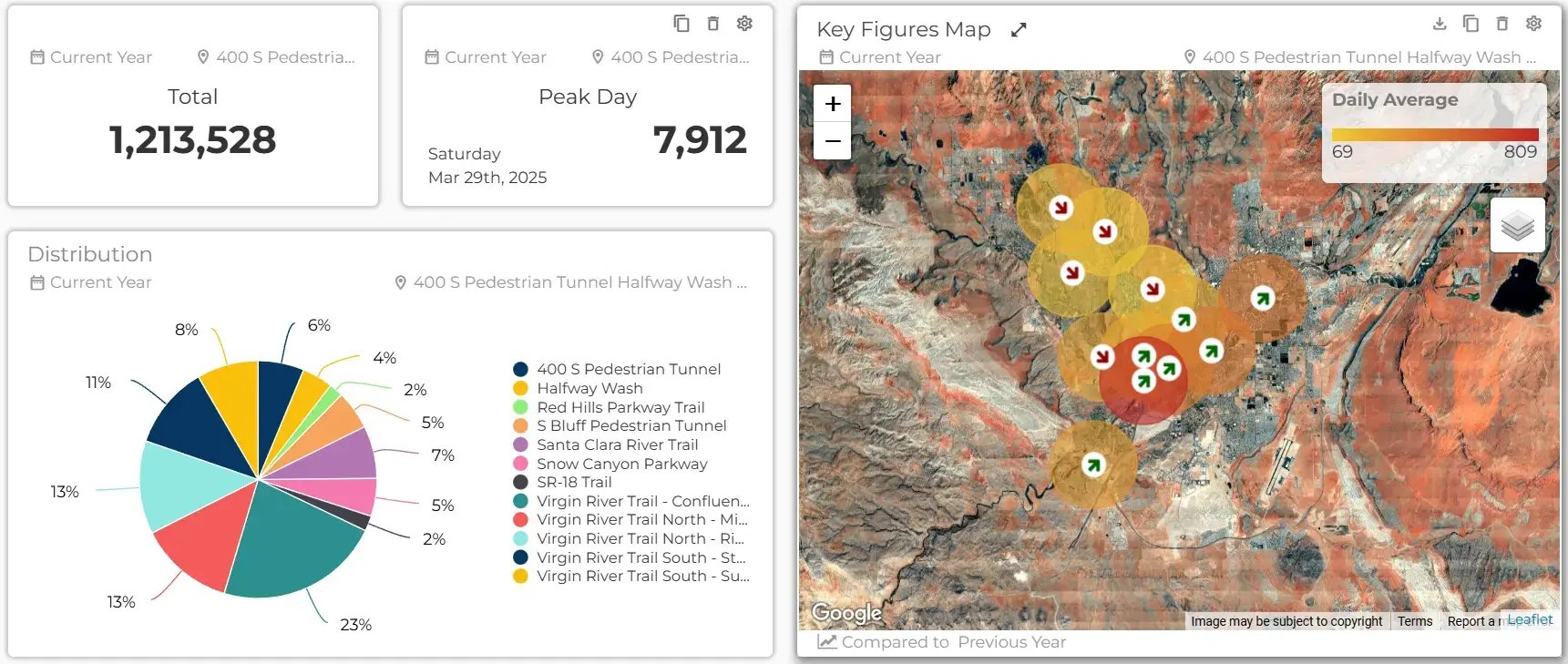 A snapshot of St. George's Eco-Visio dashboard.
Their counters collected pedestrian and bike volumes continuously for the entire year, giving them their first benchmark figure of 1.1 million counts in 2024. They also began to see which trails were more popular and the direction of travel of trail users. Energized by their first year’s success, the city went on to buy 10 more MULTIs and a few mobile counters in partnership with the neighboring communities of Ivins City, Hurricane City, Washington City, and Washington County.
Lloyd Sutton, Active Transportation Coordinator for the City of St. George, grew the city’s count program to what it is today. His job is to gather data, secure funding, and, of course, prove the return on investment of the trails.
 |
“We were spending millions of dollars on our trails and lots of people were asking me: ‘Are we getting benefit out of this money that we're putting in?’ And up to that point nobody could answer those questions. Now with the data we can, we can put a value to it.” - Lloyd Sutton, Active Transportation Coordinator for the City of St. George |
A rapid success with long-term results
What the data revealed
In just two years of continuous counting, St. George went from guessing to knowing many facts about their trails.
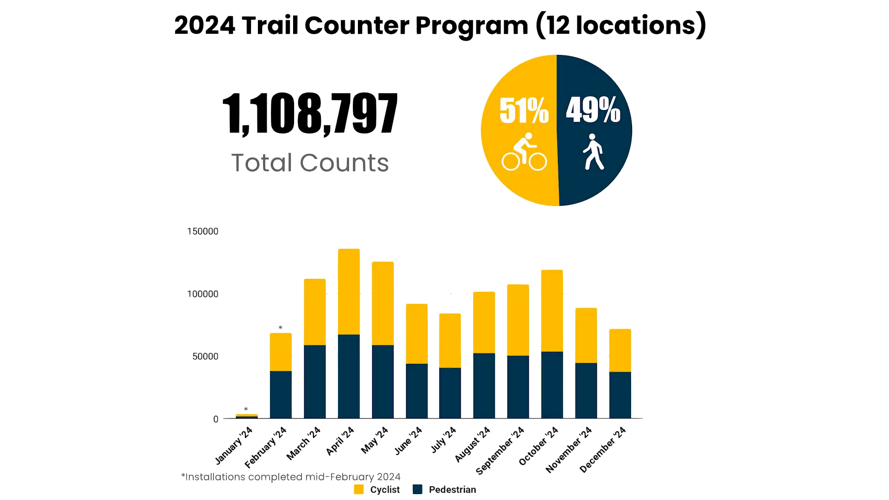
An infographic created by St. George using their count data from 2024.
They learned that their trails were getting busier, as their original 12 counters logged over 1.2 million counts in 2025 (a 9% increase). The city also learned that April and October were their peak seasons, accounting for over 20% of their total counts, and that Saturdays and Mondays were their busiest days year-round.
- Over 1.2 million counts in 2025 on their original 12 counters, a 100,000 increase (9%) from 2024.
- April (11%) and October (10%) were their busiest months, representing over a fifth of their annual counts.
- Mode share on their trails was 52% cyclists and 48% pedestrians.
- Unsurprisingly, Saturday was their busiest day (18% of annual counts) while Monday was their second busiest day (14% of annual counts).
- Most trails had peaks around 9 a.m. with a steady drop off throughout the day, suggesting that these trails were mostly used for leisure. However, certain trails had peaks at 9 a.m. and 5 p.m. on weekdays, signaling utilitarian usage.
How their data changed their trails
With their count data, St. George was able to make smarter decisions about their trails. They used peak hours to schedule maintenance when it would impact users the least. They identified the most popular areas where they should target expansions. They also learned how visitation changed each season. All this helped them create a better experience for their trail users.
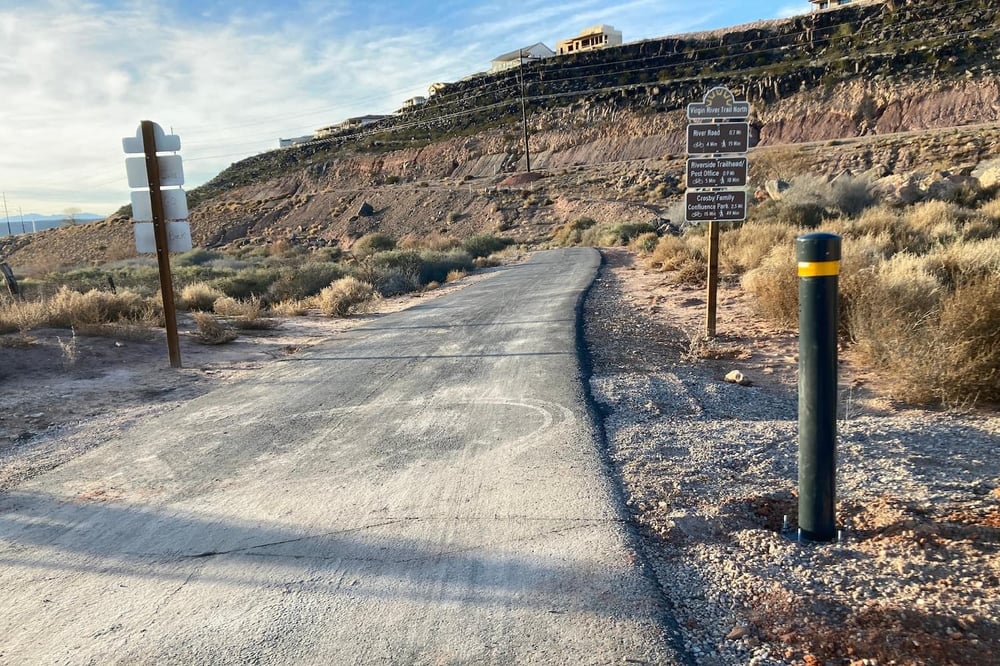 An Urban MULTI on a trail in St. George.
In one specific instance, they pushed back on a developer’s request to shut down a portion of a trail during construction because it “wasn’t being used”. Using their count data, the city proved that a considerable number of people would be forced to take a three-mile detour, prompting a change of plan.
On the funding side, publicizing their trail count data helped the city win voter approval for a general obligation bond for parks, trails, and recreation in 2023. Once the bonds were approved, St. George funded trail projects that led to two new trails completed as of 2025 with nine more on the way.
|
“I think the data was really important for the public perception of that bond. There's general support for the trails and recreation in our community, but being able to advertise the actual usage with real numbers really pushed us over that threshold for getting support for it.” - Lloyd Sutton, Active Transportation Coordinator for the City of St. George |
Future possibilities
St. George’s count program is picking up steam at a great time. According to studies, Utah’s traffic is getting worse, especially in St. George. In response, the Utah Department of Transportation (UDOT) announced the Utah Trail Network, a statewide, decades-long trail project that would change the way Utahns travel. This “freeway” of protected multi-use paths for pedestrians and bikes would connect numerous cities across the state.
Already known for their flourishing trail network, the plan proposes a significant expansion of St. George’s current trails. With their count data, the city will be able to say exactly where trails are needed most and make data-backed propositions to UDOT.
Lessons from St. George’s count program
St. George’s case shows that there is a stark difference between having a count program and not tracking data at all. Here are two important lessons to remember when building a count program:
- Keep it simple and focused to start (i.e., one type of counter, one type of trail) and expand later once you get momentum. Regardless of how big your trail network is, the takeaway is to narrow down a clear, achievable objective when starting from zero.
- Leverage neighboring cities and communities. Chances are that your neighbors are also interested in knowing more about their trails. Getting them involved can lead to shared buying power, more resources, and additional insights, similar to how St. George collaborated with partners to obtain 10 additional counters.
Learn more about their trail count program: