.webp?width=205&height=50&name=LOGO_EN_LARGE%20(1).webp)

Global Growth: Cycling Traffic Up by 5% in 2025
Across all studied countries, cycling usage increased by 5% between 2024 and 2025, with consistent growth observed on both weekdays and weekends. This trend underscores a global shift toward sustainable mobility and active lifestyles, and is interesting to observe as it is the second consecutive year of increase after a post-COVID decrease (2020-2023).
.webp?width=554&height=459&name=Average%20bicycle%20traffic%20(2019%20-%202025).webp)
Spotlight on Top Performers: Ireland, Belgium & Sweden
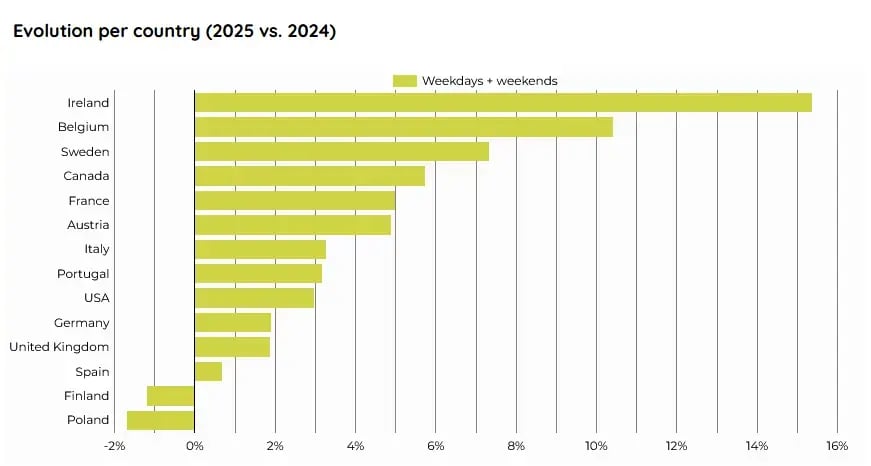
Ireland leads the way with a 15% increase in cycling traffic in 2025 compared to 2024. The country’s commitment to cycling is evident in its National Cycle Network, a €677 million initiative aiming to create 3,500 km of safe cycling corridors by 2030, connecting 200 towns and villages and serving 2.8 million people.
Belgium saw a 10% increase in 2025, thanks to its BeCyclist 1.0 plan, which introduced cycling allowances and a national bike registry. The upcoming BeCyclist 2.0 plan promises further improvements, including mandatory bike registration, better infrastructure at train stations, and a focus on cycle tourism.
In Sweden, bicycle traffic increase between 2024 and 2025 thanks to several combined factors which are present in many countries: public investment in cycling infrastructure, national policies aimed at making cycling a pillar of everyday travel, and the growing popularity of electric bikes, which make longer journeys more accessible to a wider audience. Added to this is a heightened awareness of climate and health issues, which is encouraging residents to abandon their cars in favor of more sustainable modes of transport such as cycling.
What About North America? United States & Canada Trends
In the US, cycling traffic grew by 4.7% in 2025, with regional variations. The West Coast and Northeast regions showed significant gains, reflecting ongoing investments in cycling infrastructure and urban planning.
Canada’s cycling traffic grew by 5% in 2025, with both the West Coast and East Coast regions showing resilience despite a cold end to the year.
Key Insights by Country (2025 vs. 2019)
Using 2019 as a baseline, global cycling traffic has increased by 20.4% in 2025. After a surge in 2020—driven by the pandemic and a need for outdoor activity—traffic stabilized at around 8% above 2019 levels in subsequent years, before rising again in 2024 and 2025.
| Country | % Evolution 2019-2025 Weekdays | % Evolution 2019-2025 Weekends |
% Evolution 2019-2025 Full Week |
|---|---|---|---|
| Belgium | 59% | 46% | 56% |
| France | 54% | 51% | 53% |
| England | 20% | 41% | 26% |
| Ireland | 14% | 42% | 22% |
| Italy | 13% | 39% | 21% |
| Spain | 18% | 13% | 17% |
| Poland | 16% | 16% | 16% |
| Austria | 14% | 18% | 15% |
| Sweden | 13% | 18% | 15% |
| Canada | 6% | 11% | 7% |
| Germany | 4% | 9% | 6% |
| USA | 4% | 4% | 4% |
| Portugal | 3% | 4% | 3% |
| Finland | -7% | 3% | -4% |
| All countries | 18.6% | 24.8% | 20.4% |
What’s Driving the Growth?
- Policy Support: National cycling plans, such as Ireland’s National Cycle Network and Belgium’s BeCyclist 2.0, are accelerating infrastructure development and public engagement.
- Climate and Health Awareness: The global shift toward sustainable mobility and active lifestyles continues to drive cycling adoption.
- Urban Planning: Cities are increasingly prioritizing cycling infrastructure, making it safer and more convenient for daily use.
Explore the Data Further
Eco-Counter provides tailored studies and real-time data to help cities, regions, and organizations understand and promote cycling. Whether you need a global overview or a localized analysis, our team is here to support your goals.
Let’s keep the conversation going!
Want to dive deeper into the trends for other countries or discuss a customized study for your region? Contact us to explore how Eco-Counter’s data and analysis can support your initiatives.