.webp?width=205&height=50&name=LOGO_EN_LARGE%20(1).webp)
At a Glance
- 14 years of continuous monitoring providing long-term evidence for infrastructure investment decisions as 14 million journeys were recorded across the iconic Peace Bridge since 2011
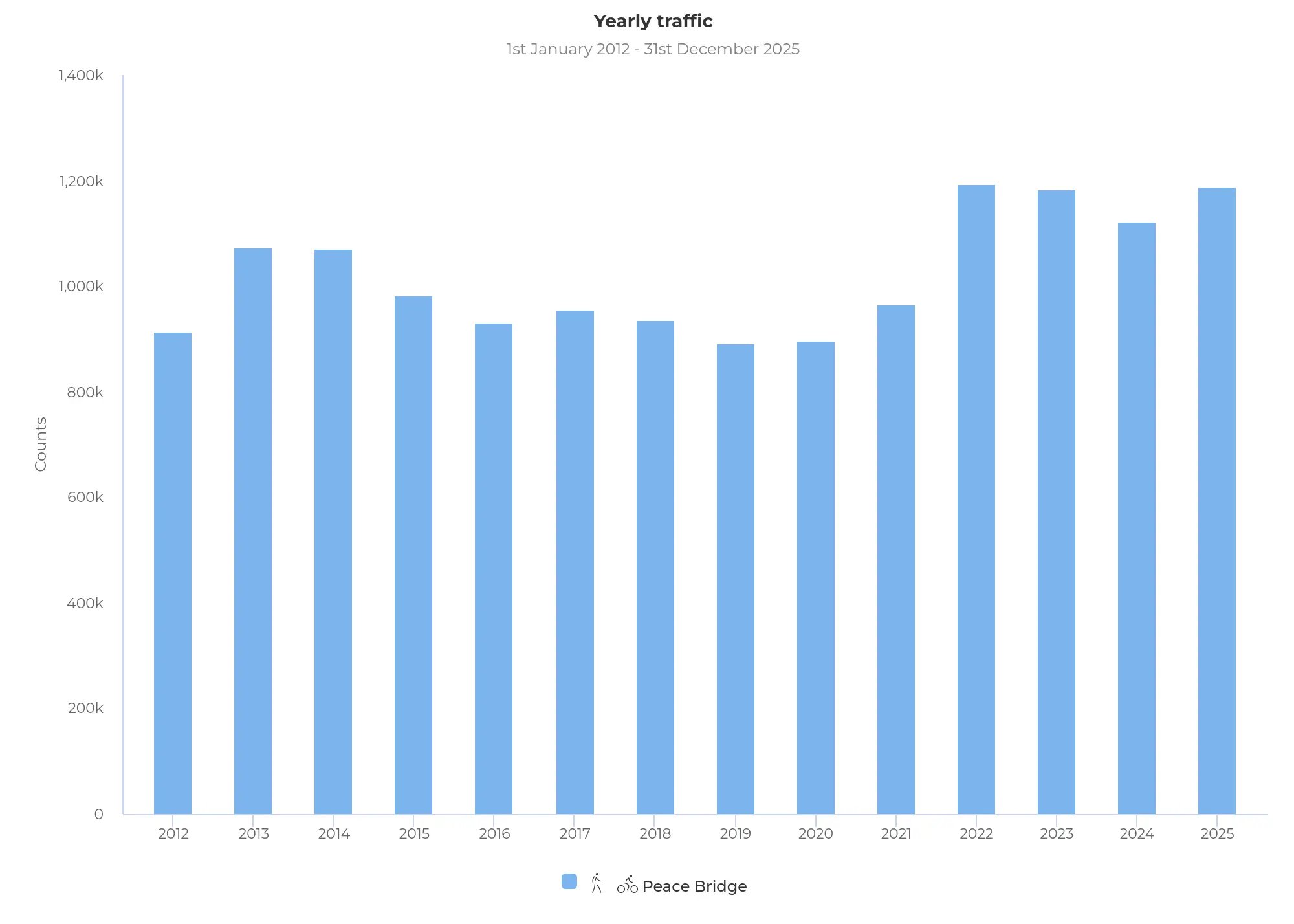
- 1 million crossings per year on average, proving consistent community adoption
- 30% traffic increase over 14 years, demonstrating growing active mobility demand
- 93% pedestrian usage (13 million walkers) with 7% cycling (1 million cyclists)
- £14 million European Regional Development Fund (ERDF) investment validated through comprehensive usage data, enabling additional funding for active travel projects
Context
A New Chapter for the City
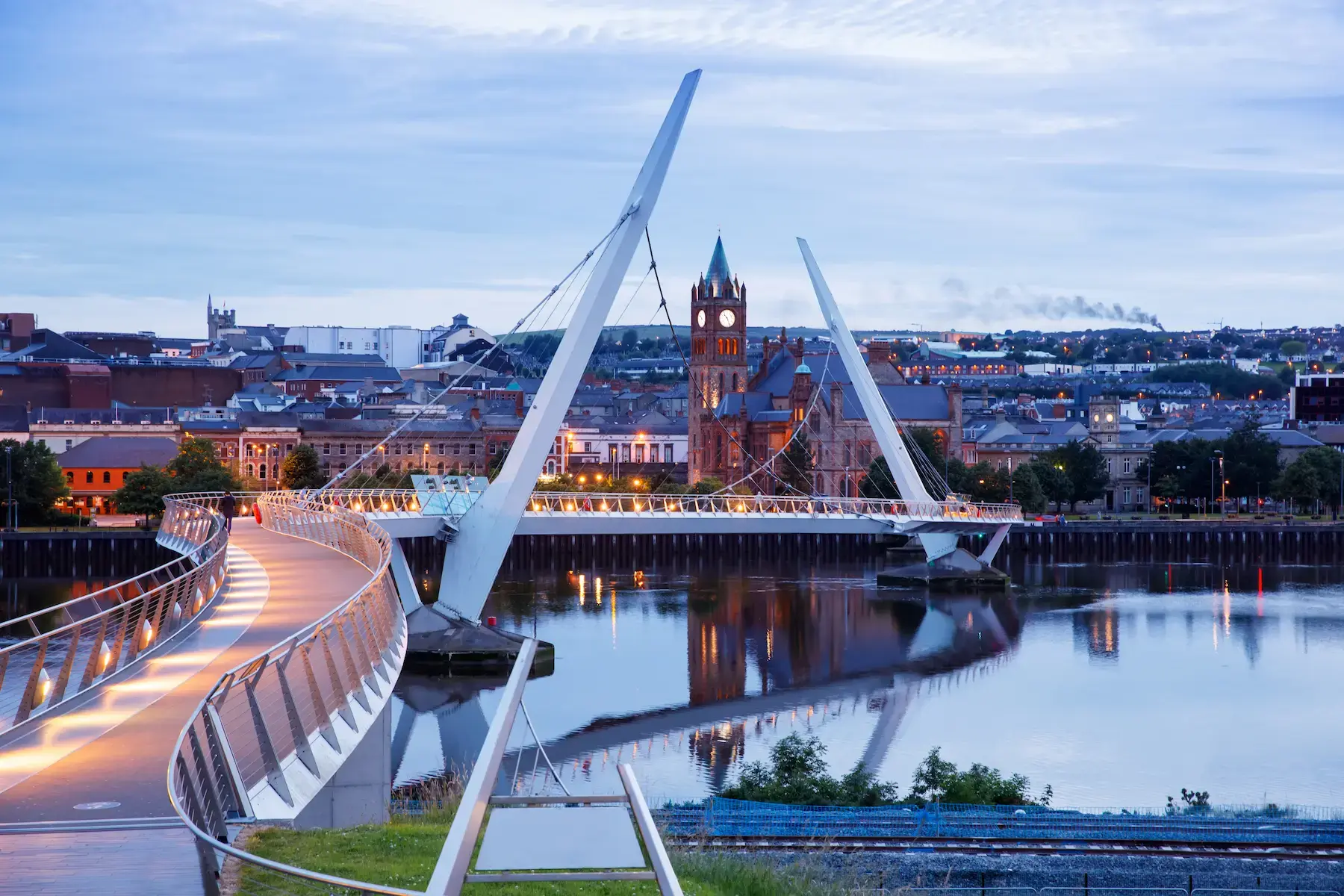
The EU-funded €14 million Peace Bridge opened in June 2011 and marked the beginning of a new chapter in the life of Derry~Londonderry. Its completion has been truly transformative in changing the orientation of travel across the city, making it much easier to reach the City Centre from the East and, in turn, the Ebrington former military base from the West Bank of the River Foyle.
A Data-Driven Partnership
Derry City and Strabane District Council (DCSDC) have worked closely with Traffic Technology since the beginning of the project. This relationship has provided robust, real-time data when required by funders and stakeholders. As the city continues to roll out its plans to extend active travel infrastructure, the data supplied remains critical in supporting bids for funding, demonstrating real value for money and return on investment.
Outcomes
Proven Impact: Events & Active Travel
This enhanced connectivity between East and West is especially evident during large-scale events such as the BBC One Big Weekend which was held at Ebrington in 2013, with access from the Peace Bridge for the 40,000 attendees.
Halloween is also where numbers recorded by Traffic Technology equipment assist DCSDC in assessing attendance across the Peace Bridge to and from Ebrington. Used in conjunction with other Traffic Technology counters, it provides clarity on trends over time.
As well as being a focal point for events, the bridge represents a key piece of active travel infrastructure, connecting people across the city. It now opens access for the public to 100 km of greenways to the North and South of the river, with additional key links to the Republic of Ireland.
Key Metrics: Demonstrating Success
To demonstrate its importance, a quick review of the key metrics shows that during its lifetime, the Peace Bridge has seen:
- An average of over 2,600 journeys per day.
- A total of 14 million people having crossed the bridge, with 1 million cyclists among them.
- A 30% increase in usage as other greenway projects are activated.
Growth in numbers continues, with commuters, tourists, and those involved in active recreational use utilising this prized asset.
Decisions, Follow-up Actions and Learnings
The data provided by the Urban MULTI counter made a strong case for the installation of the C21R counter on the latest and fourth bridge, the Bay Road Pedestrian and Cycle Bridge, which has seen over 550,000 crossings since it opened in May 2024.
Increasingly, it is mandatory for projects of this type to integrate counters pre- and post-project to enable baseline data collection and assist in post-project evaluation. In the latest case, Traffic Technology counters are being used to determine pedestrian patterns in a park area with no public lighting. This data will form the basis for the case for funding the lighting. To date, the data shows that numbers fall to zero after dark.
The robustness and accuracy of the data are increasingly in demand as projects move forward. DCSDC sees a key role for these monitoring systems as they roll out the £310 million City Deal, which plans to radically change road infrastructure, ensuring traffic segregation from pedestrians and cyclists. DCSDC also mentions: “the affordability of the technology - as time has gone on it has fallen in real terms with increased functionality - thus on a cost-benefit basis it now makes sense in many existing and new locations.”
Analysis of the data illustrates that if greenways are provided or lighting improved, usage of these areas will increase.