.webp?width=205&height=50&name=LOGO_EN_LARGE%20(1).webp)

Context: From climate targets to data‑driven decisions
The city has built an effective strategy combining public transport, congestion charging, cycling, walking, and electrification. To reach these goals, Stockholm treats the bicycle not only as a transport mode, but as a strategic tool for climate and urban policy, noting that “cycling can contribute to individual well-being, better public health and climate benefits”.
Starting in the 1990s, the capital began implementing its first Cycle Plan, which has since evolved through multiple iterations.
The current cycling plan has six focus areas:
- Make cycling easy, safe, and secure.
- Facilitate everyday cycling in a broad sense.
- Create a coherent cycle path network.
- Plan for cycling as part of city life.
- Enable diversity among cyclists and vehicles.
- Encourage innovation and smart solutions.
The challenges: Why Stockholm needed cycling data
For planners and decision‑makers, reallocating space from cars to bikes and pedestrians always carries political and operational risk. And the key question remains: “How do we know which measures are working to become climate-neutral, and how do we make sure we reach 15% of all trips made by bicycle during peak hours by 2030?”
This is where continuous cycling data becomes essential: it is how Stockholm officials check whether policies such as congestion charges, winter maintenance priorities, or urban redesign projects truly change behavior.
To answer those issues, the city progressively equipped itself with Eco-Visio data platform to understand cycling trends and behaviors at 40+ key locations in the city.
.webp?width=700&height=558&name=image(29).webp) Map of existing bicycle counters in Stockholm
Map of existing bicycle counters in Stockholm
Outcomes: What the data made possible
Measuring network expansion impacts
On key corridors, automatic permanent counters show how adding safe, connected lanes is associated with the +66% growth in daily cyclists in the city center in a period of ten years (source : Stockholm's City Plan, April 2025).
.webp(1).webp?width=2000&height=919&name=chart(41).webp(1).webp)
Analyze the impact of “bicycle highways”
High‑capacity routes connecting suburbs with the city center are monitored to confirm they are used heavily for everyday commuting and not only recreation.
Graph below is showing clear morning and afternoon peaks, indicating the network of high-capacity routes is vastly used for commuting purposes.
.webp?width=2000&height=1026&name=chart(43).webp) Hourly profile on key bicycle highways counting sites (20 sites)
Hourly profile on key bicycle highways counting sites (20 sites)
Support winter cycling policies
To support year‑round cycling, Stockholm gives bike lanes high priority in winter maintenance for its 260km of cycle routes through “sopsaltning” (brush-salting), a method where the snow is brushed off.
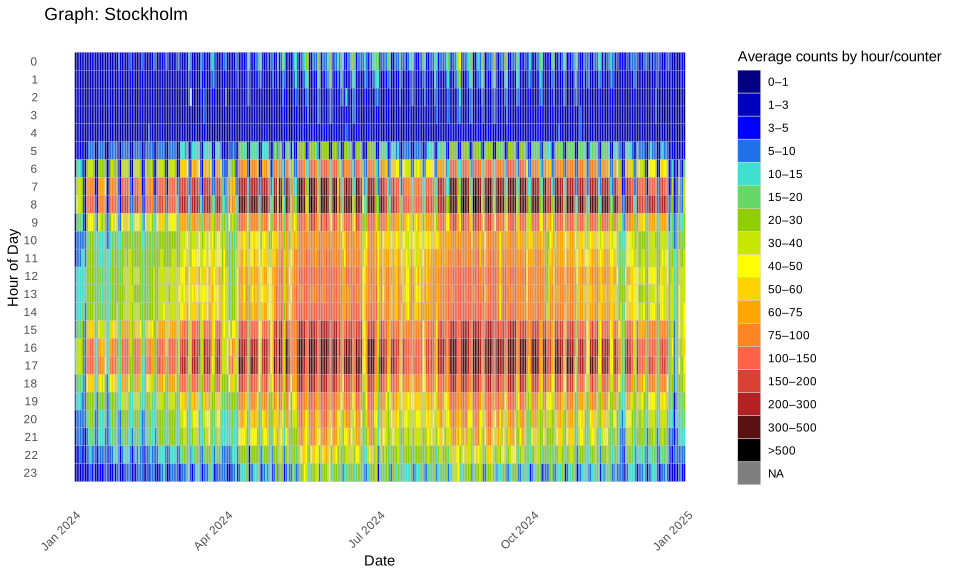
As visible on the graph below presenting the average traffic by hour across a full year (Jan 2024 → Jan 2025), it has a big impact. Average bicycle traffic remains very high even in winter times! (For reference, Montréal shows a much stronger drop in winter cycling, which is not surprising given its harsh winters, but puts it in perspective.)
Measuring climate and health benefits
Cycling data is also key to correlate with emissions and health data to show how active mobility supports those goals:
- According to Stockholm’s climate reporting, city‑wide greenhouse gas emissions have fallen by more than half since 1990. Measures taken since 2013 – ranging from bioenergy plants to promoting cycling and public transport – correspond to an additional reduction of more than 500,000 tonnes of CO₂e between 2013 and 2019.
- An interim report from a major research study suggests that increasing cycle commuting even further could save at least 80 lives a year through reduced air pollution and increased physical activity.
"It's possible to avoid around 40 premature deaths a year simply from the reduction in the level of pollution to which the Stockholm population is exposed," Peter Schantz, professor at the Swedish School of Sports and Health Sciences, told Svenska Dagbladet on Friday.
- More globally, economic analyses of cycling infrastructure consistently show strong benefits for the development of cycling usage, once lower healthcare costs, reduced congestion and increased local economic activity are included.
Measure street transformations impact
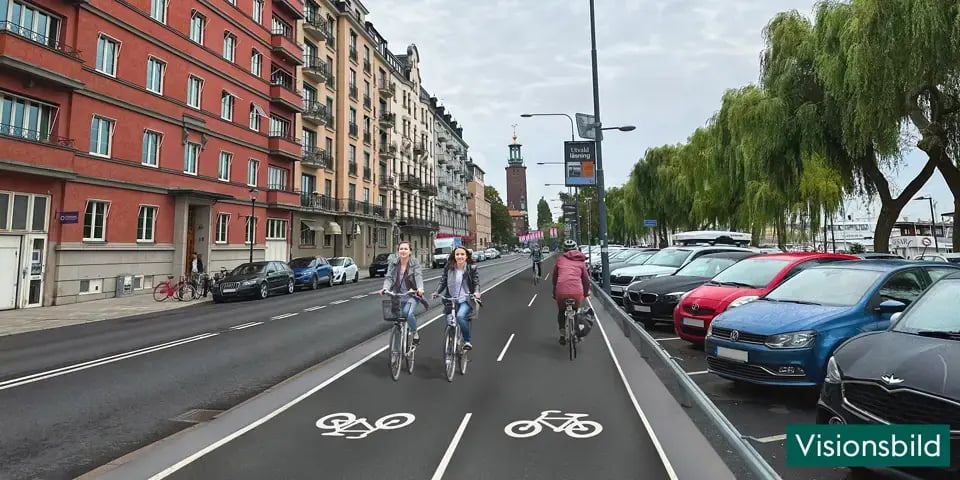
As the city is consistently growing and improving the network of cycling facilities (details of all the ongoing projects visible here: https://vaxer.stockholm/projekt/?typ=filter&fas=1%2C3&kategori=574&lista=85596&sida=1), baseline cycling counts provide a starting point to measure change. After implementation, before/after cycling and walking volumes, combined with speed and safety indicators, can allow Stockholm to prove that reallocating space from cars to people delivers the promised benefits in mobility, safety and livability. (as it did in similar projects such as Rue Saint‑Denis in Montréal and the transformation of the Quais de Seine in Paris where the urban transformation project, despite encountering strong political resistance, was an undeniable success with a whooping +212% of bicycle traffic increase between 2018 and 2025)!

|
|
Learnings
Stockholm shows that cycling data is a great proxy for measuring year-on-year progress towards climate-neutral and fossil-fuel free goals. Of course, it’s only one piece of the puzzle, as cycling is part of an integrated system to de-carbonize mobility alongside lighter freight, electrification, congestion charges and such, but it is still concrete evidence that decisions are working, and behavior changing.
It also allows to show that with the right measures, winter cycling can be an option preferred by the many, not the few! Having permanent count data enables officials to measure the winter cycling retention rate (average winter cycling traffic divided by average summer cycling traffic), and track the progress year-on-year as well.
And even though having a comprehensive view of a territory is a very good idea, any city or territory can start small with a few well‑placed counters, then use the data to justify and scale more ambitious street transformations.
In a nutshell:
- Deploy a simple, permanent counting network of automatic counters like our CITIX-AI Evo or ZELT inductive loops on strategic corridors to monitor long‑term trends.
- Use data to evaluate before/after for bigger redesign projects or the effect of winter maintenance measures
- Link cycling volumes with climate and health indicators to build a shared evidence base for decision‑makers.
Sources:
https://www.thelocal.se/20150110/boosting-stockholm-cycle-commute-could-save-80-lives-report/
https://pub.nordregio.org/wp-2023-8-nordic-cycling-policy/sweden.html
https://www.oliverwymanforum.com/mobility/urban-mobility-readiness-index/stockholm.html
https://www.uitp.org/wp-content/uploads/sites/7/2025/04/Stockholm-City-Plan-eng.pdf